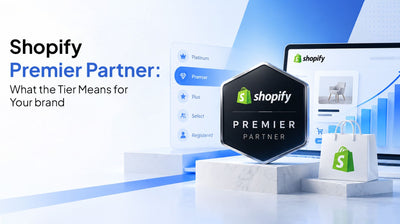
Think of Shopify partner tiers as a five-rung ladder inside the Shopify Service Partner Program: Registered, Select, Plus, Premier and Platinum. Registered is where every partner starts. You earn every level above it through demonstrated commercial impact. Agencies can't buy a rung or ask for one. Shopify decides who climbs.
How do the Shopify partner program tiers 2026 work?
Here is how the Shopify partner program tiers 2026 are measured, based on Shopify's Q3 2026 Tiering Guide. Shopify looks at three things:
-
New referral and co-sell revenue: Revenue from merchants the partner helped bring to Shopify.
-
Existing Merchant Revenue: What comes in from the stores an agency sticks around to support after the build, often through collaborator access.
-
Merchant Acquisition: How many new stores an agency has persuaded to start on Shopify.
Shopify takes the stronger of the two revenue measures, but a partner must also meet the merchant acquisition requirement for the tier it wants. Tiers refresh quarterly, on 1 January, 1 April, 1 July and 1 October.
Shopify partner tiers compared
|
Tier |
What it signals |
New referral and co-sell revenue (or) |
Existing merchant revenue |
Merchant acquisition |
|
Registered |
Starting point, core tools |
N/A |
N/A |
N/A |
|
Select |
Steady new merchants, early success |
$100,000+ |
$500,000+ |
1+ Plus/Enterprise or 10+ Standard plans |
|
Plus |
More complex merchant needs |
$500,000+ |
$2,500,000+ |
2+ Plus/Enterprise or 40+ Standard plans |
|
Premier |
Larger, more complex environments |
$2,000,000+ |
$10,000,000+ |
4+ Plus/Enterprise |
|
Platinum |
Sustained enterprise-scale impact |
$5,000,000+ |
$25,000,000+ |
6+ Plus/Enterprise |
What is a Shopify Plus partner?
Shopify Plus partner is the tier an agency reaches once it hits the Plus level of the Shopify Service Partner Program. It is a partner level, not a product. It doesn't mean the agency works only with the Shopify Plus platform. The Shopify Plus partner tier requires $500,000 or more in new referral and co-sell revenue (or $2.5 million in existing merchant revenue), plus two Plus/Enterprise merchants or forty on Standard plans.
If you're looking for agencies at this level in India, our guide to the top Shopify Plus partners in India is a good next read.
How do Select, Plus and Premier differ?
Select
A Shopify Select partner sits one step earlier, at the first level an agency earns. The merchant requirement is modest: one Plus or Enterprise merchant, or ten on Standard plans (Basic, Grow or Advanced). Many capable small and mid-sized agencies sit here.
Plus
Plus roughly raises the revenue and volume thresholds fivefold over Select. Standard-plan merchants still count toward acquisition so that an agency can reach this level through volume as well as through enterprise work.
Premier and Platinum
Premier is where the measurement changes. Shopify Premier partner requirements count only Plus and Enterprise merchants, at least four of them. Premier and Platinum measure acquisition over a trailing two years, while Select uses five. So a Premier badge reflects recent enterprise-grade activity, not just accumulated history.
Shopify Platinum partner requirements go further: $5 million in new referral and co-sell revenue or $25 million in existing merchant revenue, and six Plus/Enterprise merchants.
If you're weighing a Plus partner against a Premier one, the practical difference is scale and recency of complex work. For the hiring decision itself, see what Premier status means for merchants.
What a Shopify partner tier badge does not tell you
According to Shopify, moving up brings extra support, including a partner success manager, development funds and priority access to Shopify teams. Those benefits mostly serve the agency. A Shopify partner tier badge tells you about commercial volume, and these limits matter when you read it:
-
Revenue windows are long. Revenue is evaluated over a trailing five years so that a badge can reflect past activity as much as current capability.
-
Aggregation can flatter a team. Shopify may combine performance across an organisation's multiple Partner IDs.
-
Credentials are waived for now. Shopify verified skills used to be part of the picture, but the Q3 2026 guide says credentials are waived for 2026, and only commercial activity is evaluated. This is one of the Shopify partner program changes worth watching, because a badge may say less about skills than it once did.
-
Fit is not measured. Nothing in the criteria covers your category, your tech stack, your team size or the people who would work on your account.
A large Premier agency may serve a small brand less attentively than a strong Select agency would. A newly promoted Select team may also be a poor choice for a complex multi-market migration. And if you're still deciding whether a specialist is worth paying for at all, why hiring a Shopify expert pays off covers that.
How to use tiers when you shortlist an agency
-
Start with your needs: a standard-plan rebuild, a Plus replatform or a multi-store rollout.
-
Match the tier loosely: Select and often suit growing stores—Premier and Platinum suit large, complex programmes.
-
Ask for recent work: projects from the last two years that resemble yours.
-
Confirm the tier: check the agency's Partner Directory listing, since tiers update quarterly.
Read the badge, then check the fit.
Shopify partner tiers are a clear, public measure of commercial impact. They work well as a first filter and poorly as a final judgement. Treat the tier as evidence of scale, then test the agency on the work you need done. If you'd like to see how a team like ours approaches that, here is how we work.
Frequently Asked Questions About Shopify Partner Tiers
1. What are the Shopify partner tiers?
Registered, Select, Plus, Premier and Platinum. Every agency starts at Registered. After that, Shopify moves an agency up based on how much revenue it generates and how many new merchants it brings to the platform. You can't buy a tier, and Shopify reviews them every quarter.
2. What's the difference between a Shopify Premier partner and a Plus partner?
Mostly, it comes down to size and how recent the work is. Premier needs about $2 million in new referral and co-sell revenue, against $500,000 for Plus. It also needs at least four Plus or Enterprise merchants, and only the last two years count. Plus accepts 40 Standard-plan merchants and looks back five years so that an agency can qualify without much enterprise work.
3. What does a Shopify Select partner need to qualify?
Either $100,000 in new referral and co-sell revenue, or $500,000 in revenue from merchants it already supports. On top of that, it needs one Plus or Enterprise merchant, or ten on Standard plans. Shopify checks the numbers itself, so only revenue it can tie to the partner is counted.
4. How often do Shopify partner tiers change?
Every quarter, on 1 January, 1 April, 1 July and 1 October. Shopify looks at rolling time windows, so an agency can move up or slip down between reviews. If the badge matters to you, check the live Partner Directory listing instead of trusting a logo on a website.
5. Do agencies need Shopify verified skills to get a tier?
Not in 2026. Shopify has waived the credential requirement for the year, so tiers are based only on revenue and merchant numbers. It could come back, so check Shopify's latest guide. Until then, don't treat a certification as proof an agency is good at the work.
6. Is a Platinum partner better than a Premier partner?
Platinum is bigger, but bigger isn't the same as better for you. It needs $5 million in new referral and co-sell revenue (or $25 million from existing merchants) and six Plus or Enterprise merchants. A mid-sized brand may get more attention from a Premier or Plus team than from a Platinum agency busy with enterprise accounts.
7. Does a higher tier mean a better agency?
No. A tier counts revenue and merchants. It says nothing about the quality of the work, whether the agency knows your category, or who will actually be on your account. Use it to build a shortlist, then ask for recent projects like yours and speak to a couple of their clients.