Generative engine optimization services should measurably change how AI tools find, describe, and recommend your brand. They should not leave you with a slide deck and a promise. This guide sets out what a good provider delivers month by month, what sits outside scope, and which questions separate a credible partner from a vague one. Many shoppers now ask AI tools for product recommendations, so more brands are starting to compare providers. It is written for ecommerce teams comparing GEO services before they sign anything.
GEO in one line, and where to read more
GEO is the work of making a brand easy for AI systems to find, understand, and cite. That is all the definition we need here. If you want the full picture of how the terms relate, start with SEO, AEO, GEO, and AIO explained, then come back to judge what a provider should actually do.
What generative engine optimization services should deliver, month by month
Good AI search optimization services follow a sequence: measure first, fix foundations, publish, then verify. The table below is a reasonable shape for a six-month engagement. Timings flex with store size.
|
Phase |
What happens |
What you should be able to check |
|
Month 1: Audit |
Baseline of how AI tools describe your brand across a fixed set of prompts; crawl and indexing check; review of brand and product facts |
A written baseline listing the prompts, platforms, and dates tested |
|
Month 2: Technical foundation |
Fix crawl and indexing issues; make structured data match visible page content; clean product and catalog data |
A before-and-after list of fixes |
|
Months 3 and 4: Content |
Answer-led pages, buying guides and comparisons with original insight; a plan for earning third-party mentions |
Pages shipped, each tied to a prompt or question it should answer |
|
Month 5: Verification |
Re-run the same prompts; compare mentions, citations, and accuracy; correct wrong facts |
The same prompt set, tested again, with differences shown |
|
Month 6 onward: Monitoring |
Monthly tracking, content refreshes, reporting |
A recurring report with changes explained |
Why the baseline comes first
Without a baseline, every later claim is a guess. A useful one starts with a fixed set of prompts that mirror how your buyers ask: category questions, comparisons, problem-led queries, and brand-name searches. Each prompt runs on each platform more than once because answers vary between runs, and the date, platform, and wording are recorded. That record is what lets month five mean something. If a provider starts publishing content before measuring anything, they have no way to show what changed.
What is included and what is not
Answer engine optimization services often overlap with GEO scope, so read the scope line by line. Included work normally covers:
-
A prompt-set baseline and repeat testing
-
Technical fixes that help pages get crawled and indexed
-
Brand and product fact clean-up across your own channels
-
Answer-led content with real expertise in it
-
A plan for third-party mentions such as reviews and publications
-
Reporting you can audit
Normally outside scope, unless agreed and priced separately:
-
Paid ads and paid placements
-
Custom app or storefront builds
-
Link buying or planted mentions
-
Control over what any AI system says
GEO builds on SEO rather than replacing it
A page that isn't crawled, indexed, and useful gets little from any AI system. Google's own documentation says a page must be indexed and eligible to show a snippet to appear as a supporting link in AI Overviews or AI Mode. Traditional search engine optimization services fix those foundations, so a GEO plan that skips them is building on sand.
What no provider can guarantee
AI answers change by prompt, platform, user, and day. Nobody controls them. Google's documentation, last updated in December 2025, says you don't need special markup, new machine-readable files, or special schema.org structured data to appear in its AI features. As Search Engine Journal reported in May 2026, Google's newer guide also describes optimizing for generative AI search as still SEO. Those points are about Google, and may not apply to ChatGPT or Perplexity. Treat LLM optimization services that promise guaranteed citations or number-one placement with caution. Honest providers promise a method and reporting, not outcomes.
How brands get mentioned in AI answers
Four levers do most of the work. The first is entity clarity: AI systems need to understand who you are, what you sell, and who you sell it to, so state your name, category, and claims plainly and consistently everywhere. The second is structured data that matches what visitors can actually see on the page, which helps machines read the page correctly even though, per Google, no special markup is required to appear. The third is third-party mentions: reviews, press, partner pages, and community discussion that describe you independently. The fourth is consistent facts, meaning pricing, policies, specifications, and contact details that don't contradict each other across channels.
Content ties these together. The pages that earn citations tend to answer a question directly, then add something a generic summary can't, such as your own data, testing, or buying experience.
GEO for ecommerce: what changes
GEO for ecommerce leans on product data in ways content-only brands don't. AI shopping answers compare products by attributes such as material, size, price, and availability, so thin descriptions and missing variants cost you visibility. The work usually covers complete titles, full variant data, accurate stock and price, clear returns and delivery information, and reviews that say something specific. Consistent facts matter too: your brand name, category, and claims should read the same on your site, marketplaces, and third-party pages.
GEO for Shopify stores
GEO for Shopify has a platform angle. Shopify has been connecting merchant catalogs to AI shopping channels such as ChatGPT, Copilot, and Google AI Mode, so catalog quality inside Shopify now affects discovery. Availability and eligibility differ by region and plan, so check Shopify's current documentation before relying on any one channel. The groundwork is familiar: if you haven't covered it, read our notes on SEO for Shopify first, because clean collections, product pages and site structure feed everything above.
Who needs this now, and who can wait
GEO pays off most for brands whose products get compared in AI answers and whose basic SEO is already sound: crawlable pages, working indexing, accurate product data. If your site still has indexing problems, thin product pages or messy catalog data, fix those first, because they hold back both search and AI visibility. A very small catalog with little competition may also get more from a few well-built pages than from a six-month program. Match the scope to the stage you are at, and don't buy the whole table because a proposal lists it. If you are shortlisting an AI search optimization agency for ecommerce brands, take that scope check into the first call.
Questions to ask before you hire
Whether you pick a generative engine optimization agency in India or a global one, ask the same questions:
-
Can you show a fixed prompt set, with dates and platforms, before and after past work?
-
Which parts of the outcome are in your hands, and which aren’t?
-
Who does the technical work: your team, theirs, or a third party?
-
Do you test the prompts our buyers use, including regional phrasing?
-
What goes into the monthly report, and can you share an example?
-
What is excluded from the price?
A good GEO agency answers these without hedging. Some providers also relabel ai seo services and ordinary SEO as GEO, so ask what is genuinely new in the scope. Anyone searching for the best AEO & GEO agency for ecommerce in India will find plenty of claims, but no ranking can tell you which provider fits your store. Judge them on the method behind the pitch, not on a “best” or “number one” label.
Watch for red flags as well. Be cautious of guaranteed rankings, a pitch that treats an llms.txt file as the fix, reports that show impressions but never the prompts tested, and mentions bought or planted rather than earned. Real work is slower and more specific than that. It involves product data, page content, and evidence you can recheck.
How Seventh Triangle approaches it
Seventh Triangle offers AI commerce optimization for Shopify and ecommerce brands, a five-step service. The five steps are: Audit & Baseline, which measures current AI visibility and finds data gaps; Technical Foundation, which aligns schema, cleans up product feeds, and makes data consistent across sources; Content Optimization, which clarifies entities and builds structured FAQs and AI-ready content; Verification & Publishing, which deploys the knowledge base, validates indexing, and checks accuracy; and Monitoring & Iteration, which tracks visibility and sentiment and keeps refining. We don't claim any result will repeat for your store, since AI answers shift, and we say so up front. You can judge our proposal against the same table: a baseline, a fix list, shipped pages, and a re-test.
Choosing a provider with a clear scope
The best sign of a good partner is a scope you can check: a baseline, a fix list, shipped pages, and a re-test. Narrow AEO services that only add FAQ blocks don't make a full program either. If a proposal can't be tested that way, it isn't ready to buy.
Frequently Asked Questions
1. What do generative engine optimization services include?
A baseline of how AI tools describe your brand, technical fixes so pages can be crawled and indexed, clean product and brand data, answer-led content, a plan for earning third-party mentions, and repeat testing with reporting. Paid placements, app builds, and control over AI answers are not part of a standard scope.
2. How can I get my brand into AI answers?
Make your brand and products easy to understand and verify: state who you are consistently, keep facts identical across channels, add structured data that matches visible content, and earn mentions on independent pages such as reviews and publications. Useful, original content helps. No trick or special file forces a mention.
3. When will we see the results with GEO-services?
It depends on where you are on your site, your niche, and its competitiveness. Crawling, picking up technical fixes, and indexing new content take time. AI answers vary by run. Don’t judge progress by a promised date; judge it by seeing the same prompt set before and after.
4. Is GEO the same as SEO?
They overlap a lot. GEO builds on top of SEO fundamentals like crawlability, indexing, and useful content, and adds attention to entity clarity, product data, third-party mentions, and testing across AI platforms. Google says it’s still SEO to optimize for its generative AI features, but other AI tools might operate differently.
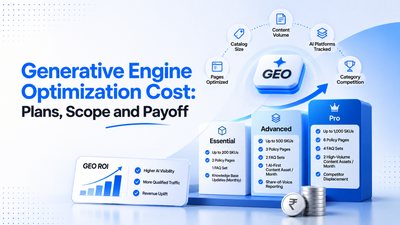
5. How much do GEO services cost?
Pricing varies with store size, catalog complexity, and how much content and technical work is included, so we don't quote a single figure. Ask for the scope in writing, what is excluded and how reporting works, then compare proposals on scope rather than on the monthly fee alone.
6. What should I ask a GEO agency in India before hiring?
Ask for a fixed prompt set with dates and platforms, what they control and don't, who does the technical work, how they test regional buyer phrasing, what the monthly report contains, and what is excluded. Be careful with guarantees and with "best agency" claims that come with no method.
7. Can GEO guarantee my store will appear in ChatGPT or Google AI answers?
No. AI answers change by prompt, platform, user, and time, and no provider controls them. A good provider can improve your chances of being found and cited and show before-and-after evidence, but shouldn't promise specific placement.