In This Article
The short answer
A successful Magento-to-Shopify Plus migration should simplify routine commerce operations while preserving the exceptional workflows that keep orders, inventory, promotions, and customer service running.
Key takeaways
· Operational edge cases are a major source of hidden migration scope.
· Every recurring workflow needs an owner, dependency map, and target-state decision.
· Discovery gives operations teams a voice before architecture and estimates are fixed.
Part 4 of 4 in our Magento → Shopify Plus series. Part 1 covered the business case, Part 2 Tech, Part 3 Marketing & Design. This last one's for whoever actually keeps the store running day to day.
The job nobody put in the JD
Ops teams on Magento tend to accumulate a quiet, unofficial job description: platform babysitter. Watching server load during a sale. Chasing a developer to fix a checkout field. Waiting weeks for a "quick" storefront change to clear a dev queue. None of it was ever written down anywhere — it just became the job.
Here's where that job actually goes when the platform stops needing to be managed.
Time to first sale, compressed
A basic Shopify store can go live in about a day; even a fairly custom build typically ships in days to a few weeks. A basic Magento store realistically takes around two weeks to stand up, and a custom build routinely runs two to three months — because a developer is needed from day one for hosting, caching, and deployment configuration, not just design.

For an ops team, that gap isn't abstract. It's the difference between launching a new region or sub-brand this quarter versus scoping it for next year's roadmap.
Automation that doesn't wait for a sprint
Shopify Flow gives operations teams no-code automation for the busywork that used to need a developer or a manual process — tagging orders, routing fulfillment, flagging fraud risk, managing inventory thresholds. Layered with B2B features like company accounts, buyer hierarchies, and net payment terms, brands running Checkout Extensibility and personalized catalogs saw B2B sales grow 25% during BFCM 2025 alone.

Worth being fair here too: on deep B2B specifics — credit-limit enforcement, RFQ workflows, multiple payment methods per customer group — Magento's native B2B module still offers more granularity today. If your ops model genuinely depends on that level of control, it's a real reason to stay. But for most brands whose B2B needs are net-30 terms, company hierarchies, and volume pricing, Shopify Plus now covers the ground that used to require Magento.
The infrastructure stops being a line item on the ops calendar
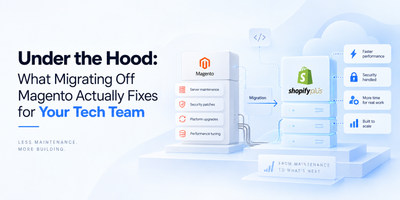
No server capacity planning before a sale. No emergency patch cycle disrupting a fulfillment sprint. No "let's wait for the developer" gating a routine catalog update. Uptime, scaling, and security patching move from being something ops has to schedule around to something that simply isn't on the calendar anymore.
In one sentence
The best thing a migration does for operations isn't a new feature — it's giving back the hours that used to go to keeping the old platform standing up.
That's the full picture across Business, Tech, Marketing & Design, and Operations. If any part of this sounded familiar, the next honest step isn't a quote — it's a free discovery workshop with Seventh Triangle: we'll map your current stack, your integrations, and your real migration effort before anyone commits to anything.
Sources: Qikify, Atwix, WebSolutionsNYC (Magento vs. Shopify Plus for B2B), and MageCloud platform comparisons (2026); Shopify BFCM 2025 press release; Shopify Flow and B2B documentation-based analyses (2026).
Frequently asked questions
How does Shopify Plus change ecommerce operations?
Teams can often manage catalogue, promotions, content, and routine store changes with less technical support, while complex order and inventory workflows may still require integrations or automation.
What operational risks should be mapped before migration?
Map order routing, inventory sync, returns, promotions, customer service, fulfilment, tax, payments, reporting, and every manual workaround relied on during peak periods.
Who should join a migration discovery workshop?
Include ecommerce, operations, technology, marketing, finance, and customer-service owners so that business-critical dependencies are documented across teams.