In This Article
The short answer
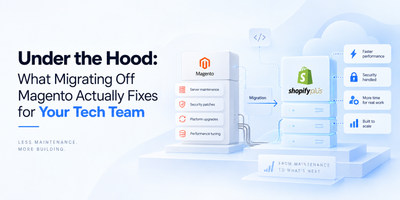
Growing D2C brands tend to reconsider Magento when infrastructure and maintenance consume resources that could otherwise support faster merchandising, experimentation, and expansion.
Key takeaways
· Scale is an operating-model question, not only a traffic question.
· Total cost includes maintenance, specialist resources, upgrades, and slower execution.
· Discovery identifies the custom workflows and integrations that must survive migration.
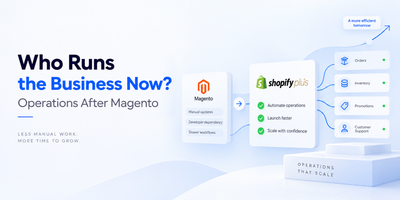
Part 1 of 4 — the business-wide view. Parts 2-4 will dig into what this means specifically for your Tech, Marketing & Design, and Operations teams.
It usually starts with a Slack message at 11 PM
Something like: "Site's slow again, can someone check the server?" If that sentence gives you a small jolt of recognition, you already know what this article is about.
Every Magento brand we've ever spoken to loves what Magento let them build. Custom pricing logic, bespoke workflows, a storefront that does exactly what the business needs and nothing it doesn't. That was never the problem. The problem shows up later — usually right around the time the brand starts winning. More traffic, more SKUs, more campaigns, more "can we just add this one feature" requests. And suddenly the platform that gave you freedom starts asking for a full-time team just to keep the lights on.
This isn't a knock on Magento's engineering. It's a fair, sometimes uncomfortable, question about where your time and money are best spent once you're past a certain size: on running infrastructure, or on running the business.
What the numbers actually say
We looked past the marketing pages on both sides and into the operating reality.
Cost has quietly flipped. Adobe Commerce (Magento's paid tier) now realistically runs anywhere from $122,000 to $450,000+ a year once hosting, DevOps, and maintenance are counted — often several times the license fee itself. Even Magento Open Source, "free" on paper, tends to land between $30,000 and $90,000 annually once a real team is behind it. Shopify Plus, by contrast, bundles hosting, security, and PCI compliance into one predictable line item, and independent analyses put its total cost of ownership 25-40% lower for most brands under roughly $50M in revenue. That's not a rounding error — that's a marketing budget you got back.

Speed isn't a vanity metric, it's revenue. Ecommerce sites that load in one second convert at roughly 3x the rate of sites that take five seconds. Every additional second of load time can cost several percentage points of conversion, compounding at scale into real money — Amazon's own famous internal study found that every 100 milliseconds of latency cost them 1% in sales. Shopify's infrastructure is built and tuned for commerce out of the box; a Magento store hits comparable speed only through continuous, deliberate performance engineering — the kind that needs dedicated hands, always.

Peak moments are where platforms get honest. This isn't theoretical. Shopify merchants moved $14.6 billion over Black Friday–Cyber Monday 2025, with sales peaking at $5.1 million per minute and the platform absorbing 30,000+ transactions per minute without breaking stride. That's the exact moment — your biggest campaign, your festive sale, your once-a-year spike — when a self-managed stack is most likely to buckle, and when it does, it's not a bug ticket, it's lost revenue you can't win back with a discount code later.

Shipping features shouldn't feel like a project. Shopify's app ecosystem now runs into the thousands of plug-and-play apps that install in minutes. Magento's marketplace is genuinely powerful, but most meaningful extensions still need a developer to install, test, and maintain — turning what should be a Tuesday-afternoon task into a small project with a small bill attached. Multiply that across a year of marketing and ops requests, and it adds up to a lot of "let's do it next sprint."
The honest trade-off
None of this makes Magento a bad platform. If your business genuinely needs deep, bespoke architecture and has the technical bench to run it as a long-term asset, that flexibility is still worth something. But for most D2C and omnichannel brands scaling past their early years, the platform conversation quietly turns into a resourcing conversation: do you want your best people solving infrastructure problems, or growth problems?
That's really what "Shopify lets you focus on scale" means. It isn't that Magento can't scale — it's that scaling on Magento usually means scaling your engineering overhead right alongside your revenue, while Shopify Plus tries to make the infrastructure boring on purpose, so your team's energy goes into merchandising, marketing, and customer experience instead.
In one sentence
Migrating isn't about admitting Magento failed you — it's about deciding that your next phase of growth deserves a platform that gets out of the way instead of asking for a team to manage it.
We've sat on both sides of this decision — literally, since Seventh Triangle was founded by people who ran their own D2C businesses before building seventhtriangle.com. We're not going to pretend every brand should migrate tomorrow, or that the answer is the same for everyone. But if the 11 PM Slack message sounds familiar, it might be worth mapping out what a move would actually look like for your specific stack — before it costs you a quote.
Next in this series: how this business-level shift plays out for your Tech stack, your Marketing & Design velocity, and your day-to-day Operations — with the specific pain points each team feels first.
Sources: Adobe Commerce/Shopify Plus TCO analyses (ECommerce Partners, Anatta, Quikly, 2026); Portent/BloggingWizard/Queue-it page-speed conversion studies; Shopify BFCM 2025 investor press release; Qikify, Scandiweb, and Empat platform comparisons (2026).
Frequently asked questions
When does a D2C brand outgrow Magento?
The clearest signal is usually operational: routine launches, upgrades, integrations, and site changes require too much specialist effort or create unacceptable risk.
Can Shopify Plus support a high-volume ecommerce brand?
Shopify Plus is designed for high-volume commerce, but suitability depends on the brand’s markets, catalogue, checkout, integrations, and custom workflows. These should be mapped during discovery.
What should be assessed before migrating from Magento?
Assess the current architecture, feature inventory, integrations, data, operational workflows, conversion gaps, and the proposed future-state solution before estimating delivery.